In the early days of the internet, “content was king” simply because there wasn’t much of it. Today, content is the atmosphere—it’s everywhere, all the time. For brands and creators, the challenge has shifted from merely producing content to ensuring that content actually serves a business purpose.
The bridge between a viral post and a sustainable brand is a Content Strategy. Without it, you aren’t marketing; you’re just making noise.
1. The Foundation: Why Strategy Trumps Spontaneity
Many businesses treat social media like a digital scrapbook—posting a photo here, a thought there, and hoping for “engagement.” However, true social media success is built on the Content Cornerstones:
-
Objectives: Are you looking for brand awareness, lead generation, or customer retention?
-
Target Audience: If you are talking to everyone, you are talking to no one. Who are they, what keeps them up at night, and where do they hang out online?
-
Brand Voice: Is your brand the witty best friend, the authoritative professor, or the adventurous rebel?
The Golden Rule: Every piece of content should answer the question: “Why does my audience care, and what do I want them to do next?”
2. The Content Pillars: Organizing Your Brain
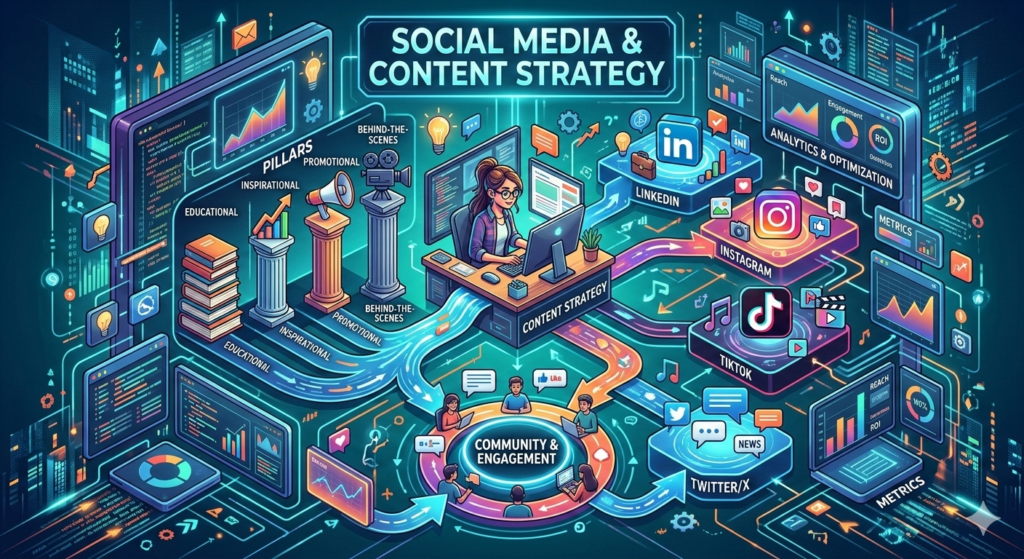
A common pitfall is “Content Fatigue”—staring at a blank screen wondering what to post. To solve this, savvy strategists use Content Pillars. These are 3–5 recurring themes that represent your brand.
For a fitness brand, pillars might look like this:
-
Educational: Breakdown of proper squat form.
-
Inspirational: Client transformation stories.
-
Behind-the-Scenes: How we develop our protein powder.
-
Promotional: Flash sale on gym gear.
By rotating through these pillars, your feed remains balanced, preventing you from being “too salesy” or too abstract.
3. Platform Dynamics: One Size Does Not Fit All
One of the biggest mistakes in content strategy is “cross-posting” the exact same asset across every platform without modification. Each social network has its own “culture” and algorithm:
Instagram & TikTok (The Entertainment Hubs)
These platforms favor short-form vertical video. The goal here is “thumb-stopping” hooks within the first 1.5 seconds. Trends move fast, so agility is more important than high-production polish.
LinkedIn (The Professional Lounge)
Content here should lean toward thought leadership, industry insights, and professional growth. People come to LinkedIn to get better at their jobs, not to see what you had for lunch (unless that lunch happened during a networking event).
X (The Town Square)
X thrives on real-time conversation and wit. It is the best place for customer service, quick updates, and engaging in trending topics.
4. The Power of "The Big Rock" Strategy
Producing original content daily is exhausting. Instead, use the Big Rock Theory.
-
Create one “Big Rock”: A long-form blog post (like this one!), a whitepaper, or a 10-minute YouTube video.
-
Slice it into “Pebbles”: Turn that blog into 5 LinkedIn posts, 3 Twitter threads, and 2 Infographics.
-
Turn it into “Sand”: Take the best quotes from the blog and turn them into Instagram Stories or TikTok clips.
This ensures your message is consistent across channels while maximizing the ROI of your creative time.
5. Metrics That Actually Matter
Don’t get blinded by “Vanity Metrics.” Having 100,000 followers sounds great, but if none of them buy your product, you have a hobby, not a business.
| Metric Type | Examples | What it tells you |
| Awareness | Reach, Impressions | How many people saw your brand. |
| Engagement | Saves, Shares, Comments | How much people value your content. |
| Conversion | Click-through Rate (CTR), Sales | If your content is driving revenue. |
Pro Tip: Pay closest attention to Saves and Shares. These indicate that your content provided enough value for someone to want to keep it or tell a friend about it.
6. Community: The "Social" in Social Media
A strategy that focuses only on broadcasting is doomed. Modern algorithms prioritize meaningful social interaction.
-
The 15-Minute Rule: Spend 15 minutes before and after you post engaging with others in your niche.
-
Reply to Every Comment: Especially in the first hour of posting. It signals to the algorithm that your post is a “hot” conversation.
-
UGC (User-Generated Content): When a customer posts about you, share it! It provides social proof that no amount of paid advertising can buy.
7. Looking Ahead: AI and Personalization
In 2026, AI is no longer just a tool for writing captions; it’s a partner in data analysis. Use AI to analyze which posting times result in the highest engagement or to brainstorm 50 hooks for a video in seconds.
However, as AI content floods the market, humanity becomes a premium. Authentic, raw, and slightly “unpolished” content often performs better because it feels real in a world of deepfakes and bots.
Final Thoughts: Consistency > Intensity
You don’t need to post five times a day to win at social media. You need to provide value consistently. A brand that posts twice a week with high-quality, helpful content will always outperform a brand that posts daily garbage.
Your content strategy is a living document. Review your analytics once a month, see what worked, ditch what didn’t, and don’t be afraid to pivot. The digital landscape changes every day—your ability to adapt is your greatest competitive advantage.